Showing posts with label monthly topic. Show all posts

June 22, 2007

virtual drink - and a footnote

on the way home from work the other day i listened to a story on npr's marketplace concerning the liters of water that go into making one liter of coca-cola -- and what the coca-cola company plans to do about it. (you can read the full transcript here.) needless to say, the fact that over 250 liters of water produces one liter of soda was shocking. there is, or course, the water that is carbonated to produce the soda (2.54 liters), but then too there is the water used to wash the equipment, and the biggest portion, the water used to grow the sugar that goes into the sweet drink (there lies the 250 liters!). now we aren't big soda drinkers in our house, but it got me to thinking, how much water are we really using? only to find that it takes approximately 140 liters of water to produce that morning cup of java i so heavily rely on.

on the World Water Council site, virtual water is defined as "the amount of water that is embedded in food or other products needed for its production". Like "carbon footprint" our bigger "water footprint" is causing a global impact.

so what can be done? you can lobby for companies to take an active role in monitoring and decreasing their water usage. buy from companies you know are making the right choices. and try to move towards a diet of less virtual water. hayley's previous post on the impact of a vegan diet on reducing carbon footprint also applies here. it takes approximately 15500 liters to produce 1 kilogram of beef. you can check out how you are doing by calculating your own "water footprint" here.

food (or should i way water?) for thought


**********
i wanted to add a "footnote" to my previous post on toenail polish. i am currently sporting a lovely pedicure of honeybee gardens polish and i couldn't be happier. it was so easy to apply. (being water-based it doesn't get all ooey-gooey if you try to go over it again.) wears very well. and while not as easy to remove as conventional polish, does come off without those nasty fumes. a more than fair trade-off i think. i took the company's advice and put it on before bed as it takes a while longer to set than the usual stuff. and i gave my toes a good soak before removal. (just popped them in the bath while watching the girls have theirs!) i have used both the peel-off and the non-peel type removed with rubbing alcohol or yes - vodka! - love both. just wanted to put the word out!

June 21, 2007

catching rain

We have a thirsty garden.

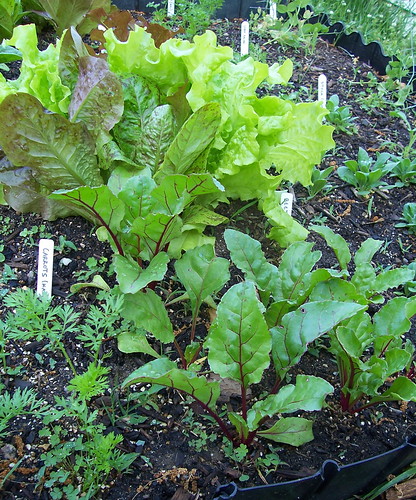
beets and lettuce

Growing our own veggies has saved us a lot of money at the grocery store this spring. Between the big bag of goodies from the CSA farm every week, and all the lettuce, carrots, beets, broccoli and mixed greens in our garden, we've hardly bought any fresh produce since March.

But the big savings on the grocery bill are being eaten into by the rather obscene city water bill. It's been a dry, dry spring here in North Carolina (USA). We've only received about half our normal rainfall, and are experiencing "moderate" drought conditions. As a result, we've been watering the garden just about every day.

We've done a lot of things to make the garden water-efficient: it's laid out in small, square blocks rather than rows, so no water or nutrients are wasted in the rows between plants. The soil is loaded with compost, because healthy soil high in organic matter retains more moisture, and we've even mixed in a bag of vermiculite to further stretch the water resources. But all that hasn't been enough in times of drought to keep us from needing to water daily.

Enter the rain barrel. We've known for a while that this would be a good idea, but it was just an abstract idea until we got the last water bill. Ugh! One water bill would easily cover the cost of a rain barrel, so off we went to the garden store.

For those who've never used one of these things, it's quite simple. You just detatch the bottom part of your gutter down-spout and route it into the top of the rain barrel. It then catches the water spilling off your roof in a rainstorm -- rather than running into the storm drains and the local creek, it runs into your rain barrel.

rainbarrel2

This barrel holds 60 gallons of water, and is made of an old pickle barrel. The screen on top keeps out mosquitoes, flotsam and jetsam, and a spout at the bottom lets you attach a hose or fill up a watering can.

My partner, HWWLLB, installed the barrel and we hopefully looked up into a hot, blue, cloudless sky, wondering when we'd get a chance to use it. Not a drop in sight, but a thirsty garden shimmered in the heat behind us. Later that night, we were awakened by the sound of thunder. HWWLLB ran around the house peering out the windows. It's raining! It's raining!

Normally the little splatter of rain that accompanies a chance thunderstorm does little more for the garden than a quick perk-up. But when we went outside the next morning, the barrel was running over. From our little roof, it took just slightly more than 1/4 inch of rain to fill the 60-gallon barrel. In general, 1 inch of rain on a 1000 sq ft roof yields 625 gallons of water. To calculate the yield of a roof, multiply the square footage of the roof by 625, then divide by 1,000. That's how much water runs off your roof in a rainstorm that generates one inch of rain.

Hm... looking around, we have 5 more downspouts - 3 more on the house and 2 on the shed. I think we need a few more rain barrels! I'm thinking of making the rest of them myself. I did build one once from directions in a back-issue of Mother Earth News (using a trash can), but we had to dismantle it at the request of our nutty former land-lady. If you know of good instructions for making your own rain barrel, please post a link!

And there's good news... a passing thunderstorm in the forecast. My barrel runneth over.

June 12, 2007

Water World! And I'm not talking Kevin Costner...

Hello there Sew Greeners! It is I, your tired, blogging delinquent contributor Amber Clisura here to give you a little knowledge about the behind the scene concept for this month.

So one of the many of the things that we have been doing over here at SG is trying to create a framework around what it is that we are doing. Now this frame will sometimes compliment what is going on inside and sometimes it will just be a little thing that you, the Sew Green reader, should take an extra second to ponder for the month. This month we are starting (albeit it a little late) on the topic of:

Water

It’s everywhere. We need it to survive. We get headaches if we don’t drink enough of it a day. Our food needs it to grow and our planet needs it to be in balance. It is the life force from which all things come. So it’s pretty damn big isn’t it?

We are hoping that this month you can take a second and observe your own water usage. Be conscious of what you’re doing. Maybe you’ll change it, maybe you won’t. We aren’t asking for anything but for you to just be open to consciousness. For our part we are going to bring you some articles that talk about virtual water consumption, perma culture pools and me? I’m going to give you 10 things that if you start them right now, not only will you be more conscious of the water you use, you will save money and water. Two things you can never have enough of in this big bad capitalist world we live within.

10. Carry your own water bottle. There is much talk about the benefits of drinking water. So do it in your own bottle and save money and the environment! Not only that but try to drink out of something that isn’t a Nalgene or a plastic bottles. Though Nalgene bottles are better than most they still off gas like any other plastic – just slower. Try a Sigg or like me, a mason jar with a lid. A little heavier but safe as can be!

9. Repair dripping faucets by replacing washers. If your faucet is dripping at the rate of one drop per second, you can expect to waste 2,700 gallons per year which will add to the cost of water and sewer utilities, or strain your septic system! It’s simple – check it out here, here or here. Just tightening the faucet isn't helping your problem so take the hour and save your planet!

8. If it’s yellow… you remember the adage don’t you? It’s valid all the time not just in drought conditions. Is it a little gross? Yeah sure it is… but the amount of water you save is amazing. Tally it for a week. Many old toilets flushing use about 7 gallons of water! Some of the newer toilets (80s and 90s) use 3.5 gallons to flush. If your landlord is super diligent then maybe, just maybe you own a toilet that uses only 1.5 to flush. On the average though a household can go through 147 Gallons of water just in toilet flushing alone! That’s almost 1800 Gallons a year! Don’t have a landlord who wants to replace the toilet? Can’t afford a new one? Easy – drop a brick in the tank and that cuts out about a gallon. Two bricks knock out two! Put the bricks in a ziploc bag or other durable holder. Bricks break down and need to be contained in order to avoid plumbing problems. Look for displacement containers at your local hardware store.

7. Don’t shave your legs/face/arms/whatever while you shower. It took me a LOOOOONG time for this one. If you can only do it while you are in the shower then turn off the water while you do it. Those five minutes of water (about 300 gallons a month) that you saved you can indulge in somewhere else.

6. Take a bath instead of a shower. Fill the tub 1/3 full and then scrub a dub dub! Use the final burst of showerhead time to rinse off. Done and done!

5. Use your gray water on plants! Fill a basin full of water for your dishes instead of keeping the water running. When done, take basin outside and water plants. No plants outside! Hang a planter box off one of your windows and plant bee loving flowers! The bees need the help right now!

4. Water your plants deeply and not frequently. This sort of thing promotes drought tolerance and creates deep roots. Also get a soaker hose for larger yards. This cuts down on over-watering and helps get water quickly to the area that needs it the most.

3. Never pour water down the drain. Ever. Where can you use it? There is another place for it. In your toilet, in your yard, in your houseplants… you get the idea.

2. Wash your hands in a basin. Fill up a small bowl and later your hands in that instead of running water.

1. (And since I’m a fashion diva) Wash your clothes in cold water and hang dry. Yes, even those cashmere sweaters! Turns out they don’t need dry-cleaning at ALL! Nope. Cashmere is just like the hair on your head. Washing it in cold with some Johnson’s baby shampoo and laying flat to dry is the best way to care for your cashmere (or any wool) sweaters. There are hand washing instructions here, here and here (use cold not hot water, color safe bleaches or environmentally safe detergents.)

I hope that this inspires you just a bit to look around your water. If you find that it is all too much – then just tell someone else to read this article. Maybe they will try one of these items out and save just a dash more water than was saved the month before. After all, every drop counts.