Showing posts with label water conservation. Show all posts

August 26, 2010

Green Housing: Getting the most out of what you have

 before (currently)

In my architectural day job I work on large projects, mostly University buildings. It might seem like a far cry from designing homes, but I realised recently that a lot of the issues that come up in my work are also relevant to how people might address their housing needs in a more sustainable way- using their (undoubtedly) limited resources in the most effective way to meet their needs. In Australia continually rising housing prices have led many people (ourselves included) to rethink how they use their existing home, instead of buying a different larger one.

Making the best possible use of existing physical resources and materials (Reusing and Recycling) is often better environmentally (and in other ways too) than building new, even if the new building incorporates the latest ‘environmentally friendly’ materials, technology and ‘green building’ design research. I find many of the homes I’ve seen on World’s Greenest Homes appalling, with regards to their consumption of resources and pursuit of brand spanking new, cavernous, luxury, even if they are using some environmentally good materials in a clever way.

I’d like to highlight 5 green building design principles about making the most of what you have already have, and explain how we have been applying them over the last couple of years, as we’ve been renovating and expanding our own home and garden. I'm not claiming that our home is one of the world's greenest, but it is certainly greener than many alternatives.

after (hopefully)

1. Think long term. Our needs always change over time, but it doesn’t make sense to address short term needs in a way that compromises long term needs, or creates a whole lot of wastage or redundant renovations.Think about the big picture master plan, not just the problem that is bugging you today. You may have a toddler now, but will you still be living in this home when they are 10? 20? 30?? (Hmmmm, scary thought...)
With a child entering into our life, we realized we needed a new craft/study room, more living space, and a dining space that could seat more than two people without rearranging the furniture. Fortunately, we had an outside space that was completely underutilized, where we could build two new rooms.

2. How else can you use it? Flexible and adaptable spaces are more useful in the long term than highly specialised spaces. Some rooms have to be single function- the kitchen and bathroom aren’t going make very good bedrooms- but can other rooms be changed around (bed/craft/lounge/dining room) as needs change? Perhaps small changes, like changing doors or windows, removing a wall, adding power points, removing fixed storage, or changing lighting will change how you can use the spaces you already have.
Our rooms aren’t big, but they’re generous enough, with doors in sensible locations, so that they can be used in different ways, with different furniture layouts. We can use our new craft/study room as a bedroom if we need to, as can a future owner.

3. Inside and Outside. Depending on your climate, at different times of the year the spaces outside your home can really expand your living space, and the kinds of things you do. Are you invited out by being able to see and hear what’s happening outside? Is the door in the right spot? Is the space outside at the same level as inside? Is it shady or sunny, sheltered from wind or rain, appropriately paved or decked?
We hardly used our back garden because you had to go through the laundry (which included a toilet) to get there, and immediately down a couple of ugly concrete steps. Not ideal, especially when you have visitors. By building a deck area and installing a new (fully glazed) back door into our kitchen, we now have much more light in our kitchen, can see how lovely the garden is, and spend a lot more time in out there.

4. Collecting water. Where we live, the price of tap water is cheap, so until the government brought in restrictions on how we use it, investing in large rainwater tanks didn’t seem worthwhile. However it’s now our legal option for watering the garden, washing the car or letting our toddler play under the sprinkler. You can also collect rainwater for toilet flushing or laundry, depending on how you set the system up. Rain and grey water collection options vary, depending on local regulations, budget, space and water needs.
We now have two water tanks- one in the front yard and one in the back, to help our efforts to set up a food producing garden and shade trees. We also have a basic grey water system set up so that we can collect bathwater to hand water our small lawn when it needs it.

5. Sun and Shade. The key to keeping a building warm (or cool), without spending money on energy, is letting the sun in (or keeping it out), along with insulating the walls, floors and roof. The potential benefits vary depending on your climate and time of year. There is also energy saving benefit if the daylight means you don’t need to turn the lights on all the time. The location and size of windows, type of glass, and any fixed, movable or growing shade (inside or outside) will all make a difference.
We packed our extension with insulation (the existing house has virtually none, so we do rely on air conditioning to keep us cool upstairs in summer) and installed large windows with special coated glass on the sunny side of the house. A sheer blind reduces glare on sunny winter days. In hotter months, we have a removable fabric sunshade that shades the window and the outside deck. All our shade trees are fast growing and deciduous (sadly not native) which means the garden gets sun in winter, but our lawn is beautifully shaded and cool in summer.

I’ve tried to keep this as a simple outline- something to perhaps get you thinking, and inspire you to investigate further. There are many resources out there for more detailed information on green building design and many of the things I’ve mentioned- too many to pick just a few. I encourage you to Google, or if you’re in Australia on 12th September, it happens to be Sustainable House Day, with many homes, all over the country, open to visitors and all their questions.

March 18, 2008

A grey water solution for someone with no plumbing skills


For a few years now I’ve not had a washing machine. It’s called for the occasional trip to my folk’s house to use their machine, and to the dry-cleaners for silks and delicates. But on the whole it’s called for a great deal of hand-washing. Lots and lots of hand-washing in a small bucket or the bottom of the bath. It’s been a little slow and laborious at times, but on the whole not too bad, save for jeans and woolly jumpers. And all those buckets of grey water were easy to cart out and pour onto the garden.

However, as soon as the option of installing both a water and energy efficient machine became possible, I welcomed it with open arms. Yay! I cried, no more 18th century washerwoman for me.

Even though my new machine is super efficient it still uses a fair bit of water. The green solution was easy, even easier than carrying bucket loads of water out to the dry, struggling garden beds. It is a grey water solution perfect for someone with no plumbing skills. Perfect for me, and perfect for you, too, I suspect.

It goes a little like this…

Walk down to local hardware shop and purchase a grey water diverter hose, 10 metres in length (minimum).


Connect the grey water diverter hose to the washing machine's drainage hose (of the same diameter). The diverter hose has a flexible plastic end to it which stretches tightly over the end of the washing machine's hose so that it doesn’t leak or separate once the machine starts a-swirling. If you’re feeling extra handy, screw on a clasp to this join to make it extra strong.


Unravel the full length of the grey water diverter hose, extending it from the washing machine, over the laundry floor, out the back door and onto the garden.

Turn Machine on and watch the grey water drain out onto the garden… you can almost catch sight of the trees and plants smiling quietly with relief.


If you have a flat garden, as I do, then you wont have the benefit of gravity to help you drain the pipe completely once the washing cycle is finished. In this case, simply disconnect the grey water diverter hose from the washing machine's drainage hose and hold this end of the grey water diverter hose up high. This will drain out what water remains in the hose.

I think the only trick is to be aware of the basic dos and don’ts of grey water usage, and more importantly what washing powder or liquid you use as this will be going onto your garden. I’ve been using this one and it seems great thus far, but there are many more eco friendly ones on the market.

There’s so much information about grey water recycling and systems, just look to your favourite green info source and I’m sure you’ll find all the details you need.

(Originally published elsewhere.)

October 11, 2007

felting in a drought

Lately I've been doing rather a lot of felting.

[For the non-knitters out there, felting, or fulling, is the process of beating knitted yarn into submission in the washing machine or using another technique to shrink the knitted item and turn it into a dense, durable mat of fiber].

I love felting, particularly for making toys. But one of the things that always bothers me about felting is using the washing machine. I feel so terrible running two whole wash cycles - all that energy and water! - just to turn a non-essential bit of knitting into a non-essential bit of felted knitting.

If you live in the mid-Atlantic or southeastern U.S., you are well aware that we're in a drought. Most of North Carolina (where I live) is now rated as "extreme" drought conditions. We've got mandatory watering restrictions, and I'm relying mainly on the bucket in my shower to get the flowerbeds through from week to week. So running two whole washing machines full of water (at something like 50 gallons per cycle - oh my god!) just to felt a toy salamander seems kind of... well, insane.

lewisi_prefelt 3
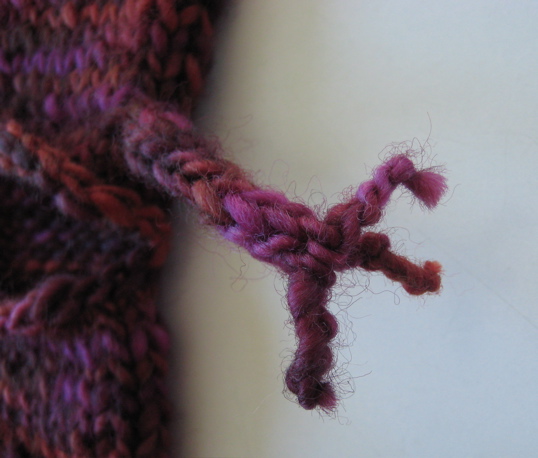
here is my knitted salamander's foot, before felting

So I am on the hunt for low-water felting methods. When I mentioned this at my local yarns store, one of the lovely ladies there suggested this method. While the energy input is still quite high, it definitely saved quite a lot of water.

1. Fill a 5-gallon bucket about halfway with very hot water and a tiny bit of mild soap. Submerge your item to be felted, and a towel, in the bucket, and get them both good and wet. Roll the item up in the towel and tie it shut with a piece of string.

2. Toss the roll-up into the dryer with a shoe or something else for agitation. Set your dryer to the lowest heat setting, and run it for about ten minutes.

3. Check your item to see how well it has felted. Repeat step 2 above until it has felted completely.

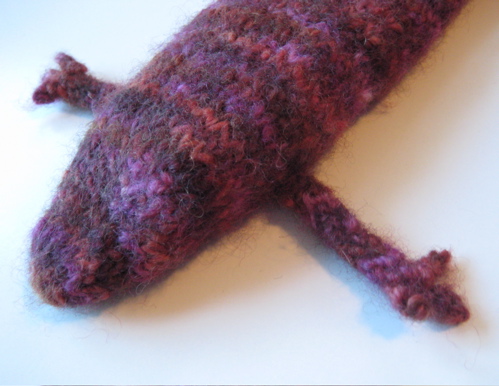
lewisi_postfelt
post-felting. someday he'll even get eyes and external gills.

I'm still looking for ways to cut the electricity, but this method definitely saved plenty of water, which I hope the real salamanders in my neighborhood creek will be happy about.

Some other things I'm thinking of trying, to eliminate the electricity:
- Needle-felting (done with unspun yarn)
- Sticking the item inside a container and dragging it behind my bike on a short ride
- Using one of those ice-cream makers where you stick the ingredients inside a ball and kick it around the yard.

Any other ideas out there?

July 4, 2007

how many gallons is this?

I can't believe it took me so long, but today I celebrated Independence Day by sticking a bucket in our shower.

water2

Then I showered. The bucket caught about a gallon of water (it was a short shower).

By my calculations, considering that I shower once a day (generally), and that I travel some and shower away from home a not-insignificant amount, I believe this here bucket will spare about 300 gallons a year from the city water treatment plant.

For good measure, I stuck a high-tech basin in the bathroom sink. Washing my hands fills it about halfway. Washing my face fills it completely. Then it's dumped into the bucket.

water1

I bet we could conservatively call that another 30 gallons a year. Of course, 2 people live here and we have my partner's water usage to consider... so we're up to about 660 gallons per year (or 2,500 liters to the rest of the world). That's more than 12 gallons per week, out to our garden beds.

flower1

How many flowers do you reckon that would water?

...and why did it take me so long to stick a bucket in the shower?

June 22, 2007

virtual drink - and a footnote

on the way home from work the other day i listened to a story on npr's marketplace concerning the liters of water that go into making one liter of coca-cola -- and what the coca-cola company plans to do about it. (you can read the full transcript here.) needless to say, the fact that over 250 liters of water produces one liter of soda was shocking. there is, or course, the water that is carbonated to produce the soda (2.54 liters), but then too there is the water used to wash the equipment, and the biggest portion, the water used to grow the sugar that goes into the sweet drink (there lies the 250 liters!). now we aren't big soda drinkers in our house, but it got me to thinking, how much water are we really using? only to find that it takes approximately 140 liters of water to produce that morning cup of java i so heavily rely on.

on the World Water Council site, virtual water is defined as "the amount of water that is embedded in food or other products needed for its production". Like "carbon footprint" our bigger "water footprint" is causing a global impact.

so what can be done? you can lobby for companies to take an active role in monitoring and decreasing their water usage. buy from companies you know are making the right choices. and try to move towards a diet of less virtual water. hayley's previous post on the impact of a vegan diet on reducing carbon footprint also applies here. it takes approximately 15500 liters to produce 1 kilogram of beef. you can check out how you are doing by calculating your own "water footprint" here.

food (or should i way water?) for thought


**********
i wanted to add a "footnote" to my previous post on toenail polish. i am currently sporting a lovely pedicure of honeybee gardens polish and i couldn't be happier. it was so easy to apply. (being water-based it doesn't get all ooey-gooey if you try to go over it again.) wears very well. and while not as easy to remove as conventional polish, does come off without those nasty fumes. a more than fair trade-off i think. i took the company's advice and put it on before bed as it takes a while longer to set than the usual stuff. and i gave my toes a good soak before removal. (just popped them in the bath while watching the girls have theirs!) i have used both the peel-off and the non-peel type removed with rubbing alcohol or yes - vodka! - love both. just wanted to put the word out!

June 21, 2007

catching rain

We have a thirsty garden.

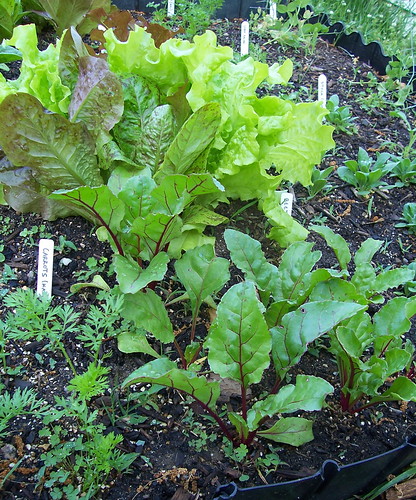
beets and lettuce

Growing our own veggies has saved us a lot of money at the grocery store this spring. Between the big bag of goodies from the CSA farm every week, and all the lettuce, carrots, beets, broccoli and mixed greens in our garden, we've hardly bought any fresh produce since March.

But the big savings on the grocery bill are being eaten into by the rather obscene city water bill. It's been a dry, dry spring here in North Carolina (USA). We've only received about half our normal rainfall, and are experiencing "moderate" drought conditions. As a result, we've been watering the garden just about every day.

We've done a lot of things to make the garden water-efficient: it's laid out in small, square blocks rather than rows, so no water or nutrients are wasted in the rows between plants. The soil is loaded with compost, because healthy soil high in organic matter retains more moisture, and we've even mixed in a bag of vermiculite to further stretch the water resources. But all that hasn't been enough in times of drought to keep us from needing to water daily.

Enter the rain barrel. We've known for a while that this would be a good idea, but it was just an abstract idea until we got the last water bill. Ugh! One water bill would easily cover the cost of a rain barrel, so off we went to the garden store.

For those who've never used one of these things, it's quite simple. You just detatch the bottom part of your gutter down-spout and route it into the top of the rain barrel. It then catches the water spilling off your roof in a rainstorm -- rather than running into the storm drains and the local creek, it runs into your rain barrel.

rainbarrel2

This barrel holds 60 gallons of water, and is made of an old pickle barrel. The screen on top keeps out mosquitoes, flotsam and jetsam, and a spout at the bottom lets you attach a hose or fill up a watering can.

My partner, HWWLLB, installed the barrel and we hopefully looked up into a hot, blue, cloudless sky, wondering when we'd get a chance to use it. Not a drop in sight, but a thirsty garden shimmered in the heat behind us. Later that night, we were awakened by the sound of thunder. HWWLLB ran around the house peering out the windows. It's raining! It's raining!

Normally the little splatter of rain that accompanies a chance thunderstorm does little more for the garden than a quick perk-up. But when we went outside the next morning, the barrel was running over. From our little roof, it took just slightly more than 1/4 inch of rain to fill the 60-gallon barrel. In general, 1 inch of rain on a 1000 sq ft roof yields 625 gallons of water. To calculate the yield of a roof, multiply the square footage of the roof by 625, then divide by 1,000. That's how much water runs off your roof in a rainstorm that generates one inch of rain.

Hm... looking around, we have 5 more downspouts - 3 more on the house and 2 on the shed. I think we need a few more rain barrels! I'm thinking of making the rest of them myself. I did build one once from directions in a back-issue of Mother Earth News (using a trash can), but we had to dismantle it at the request of our nutty former land-lady. If you know of good instructions for making your own rain barrel, please post a link!

And there's good news... a passing thunderstorm in the forecast. My barrel runneth over.

June 19, 2007

Every Last Drop {Saving Water}


Every Last Drop - this is the title of the book I’m reading at the moment (Every Last Drop: The Water Saving Guide by Amy Carmichael and Craig Madden), a book which has just recently been released in Australia through Random House Publishing.

I’m only half way through, but already I’ve picked up a few new water saving tips along the way. The book seeks to inform you on ways to save up to 50,000 litres of water a year. 50,000 litres! According to Every Last Drop, the average Australian uses 100,000 litres per year... a statistic that I find very scary to say the least.

I believe I use 65 odd litres a day, on average. I have days as low as 45 litres, but if I’m honest I know there are days when the usage is much higher than that. This means I use about 23,725 litres a year, a figure which still sounds like an awful lot to me.

If I continue with being honest then I can also admit to my water usage prior to making conservation and sustainability a focus in my life (which has been the case for the past year or two) as being (according to an old water bill) closer to 160 litres a day. That means I was using closer to 57,600 litres of water per year. How shameful is that? All these stats are derived from what is on my home water bill, and from readings on the water meter located in the front garden, hidden partially by clumps of violets. I work from home so I think this gives a pretty comprehensive overview as to my total water usage, though I should add on a few litres here and there for the hours I leave the house. I should, I guess, also calculate all the water that is used to produce the food and products I use on a daily basis. Did you know that it takes 264 litres of water to produce a single glass of milk? (p.18 Every Last Drop)

Anyway, I just wanted to air my water usage, my dirty linen, to show everyone that knowledge really does equate to change. I think Tim Flannery (author of The Weather Makers) said it most eloquently when I saw him recently on TV… unfortunately I can’t remember the quote word for word, but it was something along the lines of… knowledge is an interesting thing, once people are aware of the issues they can’t use ignorance as an excuse for inaction.

Once I realized how much water was used every time the toilet is flushed (twenty per cent of the water we use in our homes is flushed down the toilet - p.83 Every Last Drop), and the shower is used... or how much power it takes to heat water, and how much energy is wasted when an electrical appliance is left on standby, I started to turn the TV and computer off at the power point, I started to have shorter showers, I started to use less hot water. Something we all can do, and something more people will be doing after they read this book, and others similar. Or even this blog.

So, if you’re in Australia (as the book is targeted at primarily an Australian audience) and you want to know how to start making changes in your life then I’d highly recommend this paperback. It explains why conserving water is so important globally, but most importantly in Australia where our fresh water supplies are under so much strain.

Some of the top tips in this book include...
"Only boil as much water as you need when you make a cup of tea – you don’t have to fill the kettle all the way up.
Wash vegetables in a basin or tub – not under a running tap.
And use grey water from your bathroom to flush your toilet."

There is also practical advice on home plumbing jobs such as how exactly to replace a washer, and handy information in regard to installing rainwater tanks and grey water systems. All things (aside from the washer) that I wish I could do around the home if I only had the $$$.

While I’m on a book recommendation posting I thought I should also mention my all time favourite green book, which is Greeniology by Tanya Ha. If you only ever get to read one book about your personal impact on the environment then this should be the one. I think it is summarized well on the Planet Ark site… Greeniology - How to live well, be green and make a difference shows you how to change your ways without sacrificing your lifestyle. A great practical guide to reducing your impact on the environment.”

So go ahead and be green. Be water wise!

***Post script***
24th June, ‘07
I’m now nearing the end of this little book and the facts and statistics have made it a real page-turner. The chapter on water use in agriculture was particularly interesting, and it was good to read some actual statistics and figures as opposed to generalisations. Cotton, rice, livestock, pasture and grain producers are all, as we know, big water users… you can find out a little more on this here, at savewater.com.au.

And for those in the northern hemisphere, the author suggests reading Diet for a new America by John Robbins. I haven’t read it myself but I thought it may be of interest for those not in the southern hemisphere. If you’ve already read it, do let me know your thoughts on it.

June 12, 2007

Water World! And I'm not talking Kevin Costner...

Hello there Sew Greeners! It is I, your tired, blogging delinquent contributor Amber Clisura here to give you a little knowledge about the behind the scene concept for this month.

So one of the many of the things that we have been doing over here at SG is trying to create a framework around what it is that we are doing. Now this frame will sometimes compliment what is going on inside and sometimes it will just be a little thing that you, the Sew Green reader, should take an extra second to ponder for the month. This month we are starting (albeit it a little late) on the topic of:

Water

It’s everywhere. We need it to survive. We get headaches if we don’t drink enough of it a day. Our food needs it to grow and our planet needs it to be in balance. It is the life force from which all things come. So it’s pretty damn big isn’t it?

We are hoping that this month you can take a second and observe your own water usage. Be conscious of what you’re doing. Maybe you’ll change it, maybe you won’t. We aren’t asking for anything but for you to just be open to consciousness. For our part we are going to bring you some articles that talk about virtual water consumption, perma culture pools and me? I’m going to give you 10 things that if you start them right now, not only will you be more conscious of the water you use, you will save money and water. Two things you can never have enough of in this big bad capitalist world we live within.

10. Carry your own water bottle. There is much talk about the benefits of drinking water. So do it in your own bottle and save money and the environment! Not only that but try to drink out of something that isn’t a Nalgene or a plastic bottles. Though Nalgene bottles are better than most they still off gas like any other plastic – just slower. Try a Sigg or like me, a mason jar with a lid. A little heavier but safe as can be!

9. Repair dripping faucets by replacing washers. If your faucet is dripping at the rate of one drop per second, you can expect to waste 2,700 gallons per year which will add to the cost of water and sewer utilities, or strain your septic system! It’s simple – check it out here, here or here. Just tightening the faucet isn't helping your problem so take the hour and save your planet!

8. If it’s yellow… you remember the adage don’t you? It’s valid all the time not just in drought conditions. Is it a little gross? Yeah sure it is… but the amount of water you save is amazing. Tally it for a week. Many old toilets flushing use about 7 gallons of water! Some of the newer toilets (80s and 90s) use 3.5 gallons to flush. If your landlord is super diligent then maybe, just maybe you own a toilet that uses only 1.5 to flush. On the average though a household can go through 147 Gallons of water just in toilet flushing alone! That’s almost 1800 Gallons a year! Don’t have a landlord who wants to replace the toilet? Can’t afford a new one? Easy – drop a brick in the tank and that cuts out about a gallon. Two bricks knock out two! Put the bricks in a ziploc bag or other durable holder. Bricks break down and need to be contained in order to avoid plumbing problems. Look for displacement containers at your local hardware store.

7. Don’t shave your legs/face/arms/whatever while you shower. It took me a LOOOOONG time for this one. If you can only do it while you are in the shower then turn off the water while you do it. Those five minutes of water (about 300 gallons a month) that you saved you can indulge in somewhere else.

6. Take a bath instead of a shower. Fill the tub 1/3 full and then scrub a dub dub! Use the final burst of showerhead time to rinse off. Done and done!

5. Use your gray water on plants! Fill a basin full of water for your dishes instead of keeping the water running. When done, take basin outside and water plants. No plants outside! Hang a planter box off one of your windows and plant bee loving flowers! The bees need the help right now!

4. Water your plants deeply and not frequently. This sort of thing promotes drought tolerance and creates deep roots. Also get a soaker hose for larger yards. This cuts down on over-watering and helps get water quickly to the area that needs it the most.

3. Never pour water down the drain. Ever. Where can you use it? There is another place for it. In your toilet, in your yard, in your houseplants… you get the idea.

2. Wash your hands in a basin. Fill up a small bowl and later your hands in that instead of running water.

1. (And since I’m a fashion diva) Wash your clothes in cold water and hang dry. Yes, even those cashmere sweaters! Turns out they don’t need dry-cleaning at ALL! Nope. Cashmere is just like the hair on your head. Washing it in cold with some Johnson’s baby shampoo and laying flat to dry is the best way to care for your cashmere (or any wool) sweaters. There are hand washing instructions here, here and here (use cold not hot water, color safe bleaches or environmentally safe detergents.)

I hope that this inspires you just a bit to look around your water. If you find that it is all too much – then just tell someone else to read this article. Maybe they will try one of these items out and save just a dash more water than was saved the month before. After all, every drop counts.

April 13, 2007

Use only what is required & nothing more


A little while ago now I mentioned that Louise and I would be taking part in a 40 hour drought, an idea akin to the 40 hour famine that many of you would have taken part in many, many years ago now, the general idea being, to go for forty hours using 40 litres of water. Sure, simple enough, I scoffed. I drink 2 litres of water a day, that still leaves me with a whole 36 litres of water to shower, make a pot of coffee several times over, rinse afore mentioned coffee plunger and cup, clean my pearly whites and soak a jumper or two in a bucket… or so I thought.

40 litres is surprisingly, even for the water conscious among us, a very small amount. For those familiar with gallons, think approximately 10 gallons of water and you get the idea. Better yet, imagine 10 gallons of water in several small buckets and you can see it’s quite a small amount to live off. Planning on doing a load of washing in the washing machine, why, there goes another 15 litres (depending on the model and its energy efficiency rating). Ah, yes, when you consider that an automatic dishwasher can use up to 40 litres of water per load (there goes the 40 litres allowance in one fell swoop), this challenge was quite a feat. And whilst I possess neither a washing machine nor a dishwasher, I found this challenge to be just that, a huge, enormous challenge.

So, just how did I go? Well, first off, we pretended the 40 hours was just like any other 40 hours so as to fully see how much water we use day to day. We pushed and coerced the challenge to the back of our minds, wanting to see how much water we did or didn’t use in that period of time. We currently bucket our shower water out onto the garden so that took care of the garden. Water restrictions have gone up a small notch since my last posting ensuring that we only water our gardens by a trigger nozzle hose or watering system two days a week during a specified two hour window of time… between 6 to 8 in the morning (so as to minimize water evaporation) on a Saturday & Tuesday for even numbered properties, Sunday & Wednesday for the odds. Many of course flout these restrictions, particularly in the greener wealthier suburbs… but, I digress. As the challenge did not fall over the days for odd and even numbered houses to water, that took care of that. I can’t actually recall the last time I watered the garden with anything other than grey water, and whilst I miss the process, the act of watering the garden and its relaxing, unwinding ways, the garden is doing just fine with buckets of soapy water from the bathroom. So to, is my back.

Clothes were washed (as per usual) by hand, teeth washed with a glass of water rather than by a running tap, and toilet flushing, it has to be said, was kept to a hygienic minimum. We even managed to change the water in the fish tank and poured the nitrogen and phosphorous-rich water onto the potted orchids. Showers were short, and whilst soaping up, the water is turned off. So many ways to use less. Ice cubes make for effective means to water plants in hanging baskets, and pot plants can be soaked one after the other in a bucket of water… keeping the lid on pots of boiling water when cooking, installing a water softener to your tap, putting the plug in the sink when you wash your hands. I could go on and on. All these things are simple and free, everyday means of saving water. Everyday means of using less.

During our 40 litre water challenge we estimated (using a chart to pencil in how many showers were had during the 40 hours as well as there duration, how many times the half flush or full flush was used, how often we washed dishes or our hands, cleaned our teeth etc.) that we were closer to 80 litres each! Yes, double the water challenge.

In light of this, here are several water and energy saving tips for one and all, to appease my sense of guilt. I have tried to compile a list of green tips for those on a budget, for those who cannot install a rainwater tank at this very moment nor solar panels on their roof, for I am a firm believer that every little bit helps and can make a difference. Saving water is important to all of us even if you live in areas or countries were there seems a natural abundance. It is always important to treat our natural resources with care, to use only what is required and nothing more.


HANDY ECO TIPS:
* Use biodegradable cleaning products. Not only are they better for the environment, they are better for you too.

* Head to Greenpeace for wonderful recipes, such as the ones below, for using trusty Borax, soap, vinegar and Bicarbonate of soda (excellent for cleaning and deodorizing). Again, products that are better for both the environment and your family.
Recipes
Heavy Duty Cleanser 1
4 litres hot water
1/4 cup cloudy ammonia
1 tablespoon bicarbonate of soda
Mix together. For a stronger mixture, double all the ingredients except water.

Heavy Duty Cleanser 2
2 tablespoons borax
1 teaspoon soap
1 litre water
This can be stored in a spray bottle.

Hospital-quality disinfectant
Use 1/4 cup borax dissolved in 2 litres hot water. Keeping surfaces clean and dry reduces the need for disinfectants.
{Recipes for spring cleaning courtesy of Greenpeace.}

* Install energy efficient lighting and you’ll find not only is this a win for the planet it is also a win for your future energy bill.

* Long, narrow buckets especially for shower units can now be found at many hardware stores. Oates have released an 18 litre Water Saver bucket (4.75 gallons) that sits on the floor of your shower that you won’t trip over. I stumbled across this handy little number for $14.97 at Bunnings. And whilst I haven’t actually tried this as my shower is over the bathtub, I’d hazard a guess to say that it would be very hardy indeed.

* Dry your clothes on a clothes lines… logical, I know, but you’d be surprised at the amount of folk who still fling their clothes into the clothes dryer from start to finish.

* Move your thermostat down 2 degrees in winter and up 2 degrees in summer to limit your energy usage. Adjusting it by just two degrees will make a huge difference throughout the course of a year.

* Use less hot water.

* Turn off all stand-by power.

And of course, use less of everything in general. Find tips such as these and many others here (Reduce your impact at home, An Inconvenient Truth.)

Read how others who participated (and are worthy of gold stars) went here and here. I'm off to fix my leaky taps... Happy green ways, one and all!

March 20, 2007

The 40 Hour Drought - take part


When asked to join Sew Green I quite literally jumped at the chance. A blog of green-minded folk (from California to Vancouver, and recently more further a field) learning new green things together, who wouldn’t be tempted, who wouldn’t send back an immediate reply, “Yes, please! Count me in!”? So, here it is, all introductions aside in the first week, my first post, my first contribution to Sew Green, a blog that is sure to evolve into a green jungle of ideas, tips, experiences and a guide to handy, local and international resources. Cindy, Lisa S and Tracy have got it off to a flying start.

Reading Tracy’s post The grass is always greener earlier in the week on water consumption in the San Fernando Valley of Los Angeles, in which she mentioned an alarming figure, “500 gallons of water a day (…1900 litres)”, tied in perfectly with what I wanted to write about today… water. Compare that figure with 208 litres residential daily water use per capita for Melbourne (2005-06).

Here in Victoria, and indeed the rest of Australia too, water is first and foremost on the minds of everyone. Water restrictions are enforced and new water saving ways have been embraced by the many (though not all, definitely not all). A whole host of new terms have been coined thanks to the growing ranks of plastic bucket people collecting the grey water from their showers and sinks to use on their garden beds. Who could have foreseen that scores of Melbournians would take to the bucket as their new shower companion with such gusto? That phone conversations would be cut short when it was time to divert the water from the washing machine... can’t have all that water simply going down the drain now, can we? Some shower with a foot firmly planted each inside a bucket whilst others prefer to place a bucket under the shower head as they wait for the hot water to kick in. Yes, the bucket brigade is growing in ranks especially as gardens dry up due to water restrictions enforced by drought. Down pipes have been altered so as to pour onto garden beds (that is, when it does actually drizzle) and, where possible, water tanks have been installed. So many inventive techniques have been adopted and reported about in the papers, so many ways to reuse your grey water (outdoor showers anyone? Yep, it’s already been done). So many ways to also reduce the amount of water being used as well. Water has become a precious commodity no one is wasting… showers are shorter, dripping taps are being repaired and water saving shower heads are being installed… bowls are placed in sinks to catch the excess from washing your hands to rinsing your tins for recycling.

For those not Melbourne based, we are, were I live, on stage three water restrictions which means (amongst other things) that even numbered houses can water their gardens on Saturday and Tuesday, whilst odd numbered houses can water on Sunday and Wednesday. Hand-held hoses fitted with a trigger nozzle, a watering can and a bucket can only be used between 6am-8am and 8pm-10pm two days a week, with no watering permitted on a Monday, Thursday or Friday. Other areas around the country have been on such restrictions for allot longer and south-east Queensland, as of the 10th of April, is about to step up to level five water restrictions.

All this talk of water brings me nicely to the nationwide community event, The 40 Hour Drought… which poses the question; can you manage with just 40 litres of water in a 40 hour period? Take part now and register here. It commences 7am, Wednesday the 21st of March through until 11pm, Thursday the 22nd of March (Hurry, there's just enough time). Louise and I will be taking part, how about you?
(Whilst this is ‘officially’ only for Australian residents in terms of registering to take part, I think it would be both a fun and worthwhile challenge for anyone, anywhere to try to limit there water consumption to an impressive 40 litres for a 40 hour period. 40 litres is 10.57 gallons.)

You’ll find handy water saving tips here (everything from using garden friendly detergents and cleaners low in salt, phosphorous and that are biodegradable to planting drought friendly plants).

I am off now to bucket my grey water around the foot of the white flowering hibiscus tree, and I'll keep you posted on how the 40 litre challenge goes.

March 16, 2007

the grass is always greener

we live in a 1955 development in the san fernando valley of los angeles. the average temperature here in the summer is 95F (35C). (though last summer we set a record going for 21 days straight with temps over 100 degrees fahrenheit and setting an all time record of 119F (48C) on July 22 and this winter has also been the warmest on record.) average annual precipitation sits at 18 inches. (the national average is about 39 inches.)

when i first moved to my neighborhood, i wondered: how does everyone keep their lawn looking so good? (and why are we so obsessed with keeping it this way?)

green.brown

then i learned. it is estimated that the average southern california family uses 500 gallons of water a day. (500 gallons!! i think that is about 1900 litres. just think of all those milk jugs lined up...) 30% of that in the house. that leaves 70% going to watering the lawn and filling the swimming pool. i am told the figure for outdoor use is likely higher in the valley, where we receive less precipitation, and the mercury rises higher. i cannot fathom that amount of water being poured onto the ground. besides that, think of the run-off, and all the pesticides and fertilizers it is carrying out of the valley, under the santa monica mountains, and into the pacific ocean.

the history of the lawn in the u.s. relates to the housing boom that our home was part of. that ideal of suburban perfection. but it goes back further than that. back to english manor homes with grand entrances. where vegetable gardens were hidden and idyllic landscapes were constructed. lawn = success. (and it better be green!)

when we purchased our house almost six yrs ago, we talked about doing it differently. we do have a pool. (solar powered, and i dare say a must with days in the 100s.) but we don't have a lawn. well, actually we do. but it hasn't been watered. leaving it to look much more brown than green.

i like green.

so, our goal this summer is to tear it out. cap off our sprinkler system. and go native. (plus some raised veggie beds.) socal native plants are adapted to winter rains and summer drought. once established, they should need very little water other than that provided by mother nature. and we should see a considerable decrease in our water consumption.

so we are at the beginning of the journey. we have a basic plant list in hand. a rough plan drawn. and are planning a trip here to check out some specimens "in person". pointers are always welcome!

and i'll let you know how it goes...

inspiring me...
california native plant society
the american lawn
edible estates los angeles
heat wave
l.a. county dept. of public works : how to save water outside the home

update - links from the comments that i should have included! thank you thank you!
beyond pesticides
theodore payne nursery
xeriscaping
las pilitas nursery (we developed our list from this one, i love it - you can put your zip in and get the plants for your area)